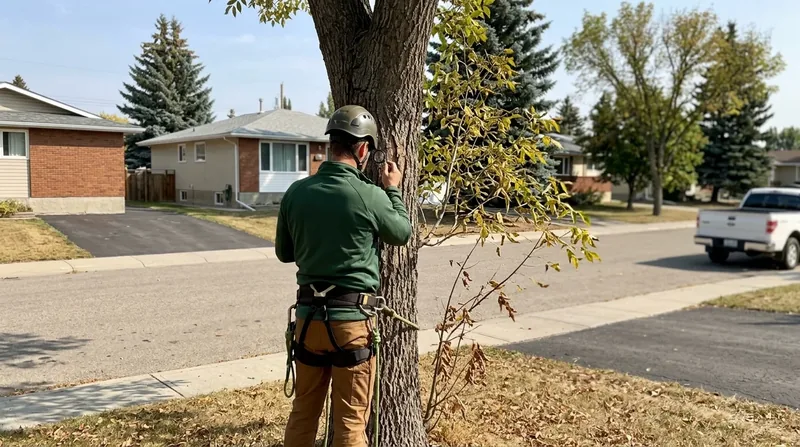




A declining tree in Calgary can signal anything from a treatable fungal infection to structural failure requiring removal. Tree disease diagnosis is an on-site examination by an ISA Certified Arborist who assesses crown condition, bark integrity, root collar health and the visible root plate to determine what can be saved and what must come out. Our crews have diagnosed and managed tree decline across Calgary since 2014, from silver and sugar maples showing dieback in post-war subdivisions to ash trees killed by the emerald ash borer on properties across the city and surrounding area. Early diagnosis often means the difference between a single treatment and full removal. We document findings in writing so you have a clear record for your own records or to support a municipal permit application if removal becomes necessary.
Why early tree disease diagnosis matters
A tree showing signs of decline is not always a candidate for removal. Canopy thinning, bark damage, or slow growth can result from soil compaction, root girdling, pest pressure, or environmental stress, many of which respond to corrective pruning or targeted treatment. Without a professional assessment, homeowners often remove healthy trees or delay action on trees that pose a genuine safety risk. In Calgary, where mature street trees anchor post-war neighbourhoods and ravine lots present steep access challenges, a clear diagnosis before any work begins protects both the tree and your property.
- We examine the crown for dieback, sparse foliage, or abnormal colour that suggests disease or pest damage.
- We assess bark for cracks, cankers, weeping wounds or areas of peeling that expose wood to infection.
- We inspect the root collar and visible root plate for girdling roots, decay or heave that signals structural compromise.
- We identify pest activity, including emerald ash borer galleries or scale infestations that require intervention.
- We provide a written opinion on prognosis and the best course of action: monitoring, treatment, pruning or removal.
This assessment gives you confidence in your next step, whether that is a treatment plan or scheduling removal with full understanding of what lies ahead.
Local insight: In the Calgary area, ash trees killed by emerald ash borer represent the largest category of removal diagnostics we perform. Early identification of EAB infestation can open a narrow window for preventive injection treatment in late spring or early summer, potentially extending the tree's life by several years and deferring removal costs.
How we diagnose tree disease in Calgary
Our process is straightforward and thorough. We arrive on site with hand tools, a magnifying glass and the trained eye of an ISA Certified Arborist. We walk the tree, examining it from multiple angles and at close range. We may bore a small increment core or scrape bark to check for internal decay, or we may use a resistograph (a non-destructive tool that measures wood density). We ask you about the tree's history: when you first noticed decline, whether there have been nearby construction or soil work, and how long it has been in that condition. We then provide a clear verbal summary on the spot and follow up with written findings within one business day.
- We inspect crown structure and foliage density, noting any asymmetry or sparse areas.
- We probe bark and wood with a sharp tool to detect soft spots or hollow sections that indicate internal rot.
- We examine the base and root collar for signs of root disease, girdling or surface heave.
- We identify visible pests, including borers, scale insects or fungal fruiting bodies on the trunk.
- We document findings with photos and notes that become part of your record.
- We discuss options: continued monitoring, targeted pruning, chemical treatment, or removal planning.
The entire visit typically takes 30 to 45 minutes for a single tree, depending on size and access. For a property with multiple declining trees, we assess them all in one trip and prioritize by risk level.
Real example: A homeowner in Bowness noticed a 25-year-old red oak with yellowing leaves in mid-summer and a hollow sound when tapped. Our diagnosis revealed internal decay from an old pruning wound. Removal was recommended within two years to avoid branch failure. The owner scheduled removal the following winter at a planned time, avoiding emergency costs and property damage.
Assessment methods and what they reveal
| Method | What it shows | When we use it |
|---|---|---|
| Visual inspection | Crown density, bark condition, pest damage, asymmetry or lean. | Every diagnosis; the foundation of assessment. |
| Bark probing | Soft spots, cankers, or areas of internal decay beneath the surface. | When bark looks intact but the tree is declining rapidly. |
| Increment boring | Ring pattern and wood colour to detect internal rot or disease spread. | Suspected internal decay or when a small sample confirms diagnosis. |
| Root collar excavation | Girdling roots, soil compaction, or root rot at the base. | Tree declining despite healthy crown; common on ravine lots in Calgary. |
| Resistograph testing | Wood density profile through the trunk to map hollow or soft areas. | Assessing structural safety before deciding on removal or retention. |
None of these methods requires climbing or heavy equipment. All are non-invasive or minimally invasive, and all produce data you can understand and act on with confidence.
When tree disease diagnosis leads to removal
Sometimes diagnosis confirms that a tree cannot be saved. If our assessment shows advanced internal decay, terminal pest damage such as emerald ash borer, or structural defects that pose a safety risk, we recommend removal. At that point, we can schedule the work directly or provide you with our written findings to share with other contractors if you prefer. Many homeowners choose to have us handle the entire project from diagnosis through tree removal, since we already understand the site constraints, access routes and any utility lines or structures nearby. If the City of Calgary requires a permit for removal, our diagnostic report supports your application and speeds approval.
Removal is not the end of the story. After we take down the tree, you may want to grind the stump to reclaim the space, or you may prefer to leave it for wildlife habitat. We offer both stump grinding and full stump removal, and we can discuss replanting options if you want a new tree in that location.
Diagnosis that supports treatment and recovery
Not every declining tree is beyond help. If diagnosis reveals a treatable condition, we can recommend specific actions. A tree with sparse foliage and poor growth may respond to crown thinning to reduce stress and improve light penetration, or to corrective pruning that removes crossing branches and restores structure. A tree showing early emerald ash borer activity may be a candidate for targeted chemical injection during the spring and early summer window. A tree on a ravine lot with compacted soil may benefit from root collar excavation and aeration to relieve soil stress. Our arborists work with you to weigh the cost of treatment against the value of keeping the tree and the timeline for results.
We also recommend ongoing monitoring for trees in recovery. A follow-up visit six months or a year after treatment can confirm that the tree is responding and that no new problems have emerged. This proactive approach often catches issues early, when options are still available.
For more information on how diagnosis fits into a complete tree care plan, contact us at (587) 333-6436 or request a free estimate at our contact page. We serve Calgary, Airdrie, Diamond Valley and Foothills County, and we are fully insured ISA Certified Arborists ready to assess your trees.
Prices Tree Disease Diagnosis in Calgary — Indicative pricing
| Service | Price | Details |
|---|---|---|
| Single tree diagnosis | From $175 | On-site assessment, written report, recommendations for treatment or removal |
| Multiple trees (3 to 5) | From $425 | Full property assessment with prioritized action plan |
| Complex case or large property | On quote | Extended assessment with resistograph testing or increment boring |
| Follow-up monitoring visit | From $125 | Reassessment of treated or recovering tree within 6 to 12 months |
| Travel | Included | In Calgary and the surrounding area |
| Free estimate | Free | Call (587) 333-6436 or request online |
Indicative prices; free, personalized estimate within 24h at (587) 333-6436.