Understanding the Risk: Why Proximity Matters
A mature spruce tree standing just a few metres from your house presents a unique challenge. Unlike trees planted in open yards, those positioned close to structures face competing demands: they provide shade and aesthetic value, yet their root systems, branch weight and growth patterns can threaten foundations, siding, roofing and utilities. Calgary homeowners frequently encounter this dilemma, particularly in established neighbourhoods where trees were planted decades ago without consideration for their eventual size.
The core issue is that spruce trees, especially species like Colorado blue spruce and white spruce common to Calgary, grow tall and develop substantial lateral branches. A mature specimen can reach 15 to 25 metres in height, with a canopy spread of 6 to 10 metres or more. When planted within 3 to 5 metres of a house, the tree's natural growth pattern creates several problems: branches overhang the roof and gutters, needles clog drainage systems, root pressure can affect foundation integrity, and in severe weather, large limbs risk falling onto the structure. Additionally, proximity reduces air circulation around the house, trapping moisture and promoting fungal growth on siding and in attic spaces.
Tree Trimming versus Removal: Weighing Your Options
Tree Trimming and Tree Removal represent two fundamentally different approaches, each with distinct advantages and drawbacks. Tree Trimming preserves the tree while reducing its size and branch density, making it a less invasive and more economical first step. Removal eliminates the risk entirely but also eliminates the tree's benefits: shade, privacy screening, wildlife habitat and visual appeal. For many Calgary property owners, the decision hinges on the tree's health, its structural integrity and the specific hazards it presents.
Trimming works best when the tree is healthy, structurally sound and the hazards are manageable through crown reduction. Tree Pruning and Crown Reduction can remove 20 to 30 per cent of the crown, opening up sight lines, improving air flow around the house and reducing the risk of branch failure during ice storms or high winds. However, trimming a mature spruce too aggressively risks disfiguring it permanently or weakening its structure. Removal becomes the better option when the tree is dead, diseased, leaning significantly, or when its root system is actively damaging the foundation. The choice is not always obvious without professional evaluation.
Signs Your Spruce May Need Removal
Certain warning signs indicate that Tree Removal is the safer and more practical choice. A Calgary arborist looks for structural defects, disease and environmental stress when assessing a mature spruce. If the tree is leaning noticeably away from vertical, especially if the lean has worsened over the past year or two, the root system may be compromised. A leaning tree near a house is inherently unstable and poses a significant liability risk. Similarly, if large sections of the crown are dead or dying, if the bark is peeling away, or if you observe cavities and hollow sections in the trunk, the tree's structural integrity is questionable and failure becomes more likely.
Dead wood in the canopy, visible fungal fruiting bodies (shelf fungi or conks) on the trunk, and evidence of pest damage such as galleries or sawdust also signal decline. A dead tree removal should be prioritized because dead wood becomes brittle and unpredictable. Branches can fail without warning, particularly after heavy snow, ice accumulation or wind. If the tree has recently suffered storm damage, lightning strike or root damage from construction or utility work, its structural resilience is compromised. In these cases, removal eliminates the hazard and the uncertainty.
The Value of a Professional Arborist Assessment
Before committing to either trimming or removal, a professional Calgary tree assessment is invaluable. An ISA Certified Arborist evaluates the tree's species, age, health status, structural form and the specific hazards it presents to your property. This assessment considers factors invisible to the untrained eye: internal decay, root collar condition, branch attachment angles and the tree's ability to compartmentalize wounds. An arborist report also documents the tree's condition in writing, which is essential if you need to apply for a municipal permit or file a claim with your insurance provider.
The City of Calgary may require a permit for private tree removal on residential property, particularly for trees above a certain size or in environmentally sensitive areas. An arborist opinion strengthens your permit application by providing objective evidence that removal is justified. Beyond regulatory compliance, a professional assessment protects you from making a costly mistake. Removing a healthy tree that could have been managed through trimming wastes money and loses the tree's benefits. Conversely, attempting to preserve a hazardous tree through cosmetic trimming creates ongoing liability. Chinook Tree Trimming can provide a comprehensive assessment and recommend the most appropriate course of action for your situation.
Trimming Strategies for Trees Close to Houses
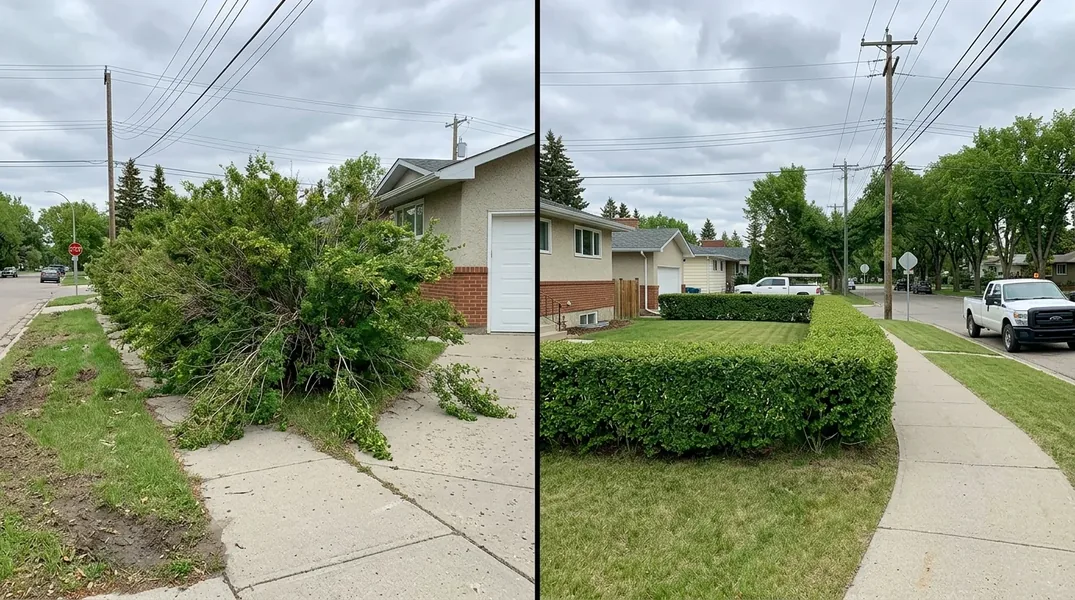
If your spruce is healthy and structurally sound, strategic Tree Pruning and Crown Reduction can mitigate many proximity hazards. The goal is to reduce the crown's overall mass and volume while maintaining the tree's natural form and structural integrity. This typically involves removing dead or diseased branches first, then selectively removing lower branches to increase clearance from the roof and walls. Upper branches are thinned to improve light penetration and air flow, reducing the risk of fungal issues on the house exterior.
A key principle is never removing more than one-third of the living crown in a single year. Aggressive cutting weakens the tree and can trigger excessive sprouting or disease. Instead, a multi-year trimming plan gradually reshapes the tree and reduces its proximity hazards. Professional arborists use proper pruning cuts that heal cleanly and don't leave stubs or damage the branch collar. For a mature spruce planted too close to your Calgary home, this incremental approach is often the most effective way to preserve the tree while reducing risk. Contact Chinook Tree Trimming at (587) 333-6436 to discuss a customized trimming plan for your property.
Planning for Removal: Process and Next Steps
If removal is the right choice, understanding the process helps you prepare and budget accordingly. Tree Removal involves more than felling the tree. A professional crew will assess access routes, identify underground utilities, plan the direction of fall, and ensure safe rigging if the tree is near structures. The trunk is cut into sections and lowered by rope to prevent impact damage. Branches are chipped on site or hauled away, and the stump is ground below ground level to allow replanting or landscaping. The entire process is designed to minimize damage to your property and surrounding landscape.
Before scheduling removal, confirm whether the City of Calgary requires a permit. A Calgary arborist can advise on this and support your permit application with documentation. Once removal is complete, you have the opportunity to plant a smaller, slower-growing species that won't outgrow its location, or to create open space for other landscaping features. Chinook Tree Trimming provides transparent pricing and will explain the full scope of work before beginning. For an immediate assessment and free estimate, call (587) 333-6436 or visit our website to request a quote.
Looking for a professional in Calgary? Chinook Tree Trimming responds quickly for all your tree trimming needs.
Get a free estimateOur services : Tree Removal · Tree Trimming · Tree Pruning & Crown Reduction